Hamk University

Visited Hamk Univirsity in Finland.

Automation Lab

The Vietnamese student in Hamk University.

EMVITET Project

LHU join EMVITET Project.

Education 4.0

Organize Minirobocon Contest 2019 for Binh Phuoc province, Viet Nam

Solar Farm in Vietnam

The total installed capacity in Buon Ma Thuot solar farm is 30.7MW

Friday, April 24, 2020

A wireless visualization monitoring, evaluation system for commercial photovoltaic modules solely in MATLAB/Simulink environment

This paper proposes a wireless photovoltaic (PV) visualization monitoring, evaluation, and fault detection system based on the STM32F4DISCOVERY board with Bluetooth data transmission in the MATLAB/Simulink platform. All of the irradiance, the cell temperature, voltage, and current of PV devices are acquired through the microcontroller-based DAQ board. These measurements data are transferred to a host computer by both Bluetooth slave module and Bluetooth master one built in a laptop. These measurement data are visually displayed in the form of dashboard in the MATLAB/Simulink environment and are simultaneously input to PV model for theoretical simulation. The functions of evaluation and fault detection for PV modules under practical working conditions are conducted and displayed at the same software platform.
The proposed system has been proved with sufficient accuracy and confidence in the functions of visualization monitoring, evaluation, and fault detection. As compared with the well-developed ones, the proposed system has the advantages such as: reduce both cable and hardware configuration and integrate the all visualization monitoring, evaluation, and fault detection solely in the MATLAB/Simulink environment.
Keywords
PV monitoring, evaluation, fault detection system
STM32F4DISCOVERY board
MATLAB/Simulink
Wireless DAQ system.
link:

Self-sufficient energy recycling of light emitter diode/thermoelectric generator module for its active-cooling application

This paper presents the energy recycling and self-sufficient application of a novel high-power light emitting diode integrating with a thermoelectric generator module. The proposed lighting module in which a thermoelectric generator device is sandwiched between light emitting diode device and heat sink autonomously recycles the waste heat to self-sufficiently support for its active cooling with an electrical fan. The start-up responses of illuminance, temperature, current and power for the proposed module were evaluated through experimental measurement. The corresponding mathematical model was derived and simulation model was built using MATLAB/Simulink for verification. The illuminance, electrical, and thermal performances have a close agreement between experiment and simulation results. The technological viability about both autonomous operation and self-sufficient energy recycling for the novel module with the active cooling was validated. Compared with passive-cooling devices, the proposed module declines the working temperature and improves illuminance simultaneously.
link:
https://www.sciencedirect.com/science/article/pii/S0196890416302151

Report of REN21 based Renewable Energy

REN21 (Renewable Energy Policy Network for the 21st Century) is a think tank and a multi-stakeholder governance group which is focused on renewable energy policy. The full report based renewable energy policy of each country as below:
Full report:
2019 https://www.ren21.net/wp-content/uploads/2019/05/gsr_2019_full_report_en.pdf
2018 https://www.ren21.net/wp-content/uploads/2019/08/Full-Report-2018.pdf
2017 https://www.ren21.net/wp-content/uploads/2019/05/GSR2017_Full-Report_English.pdf

Active model for online activities

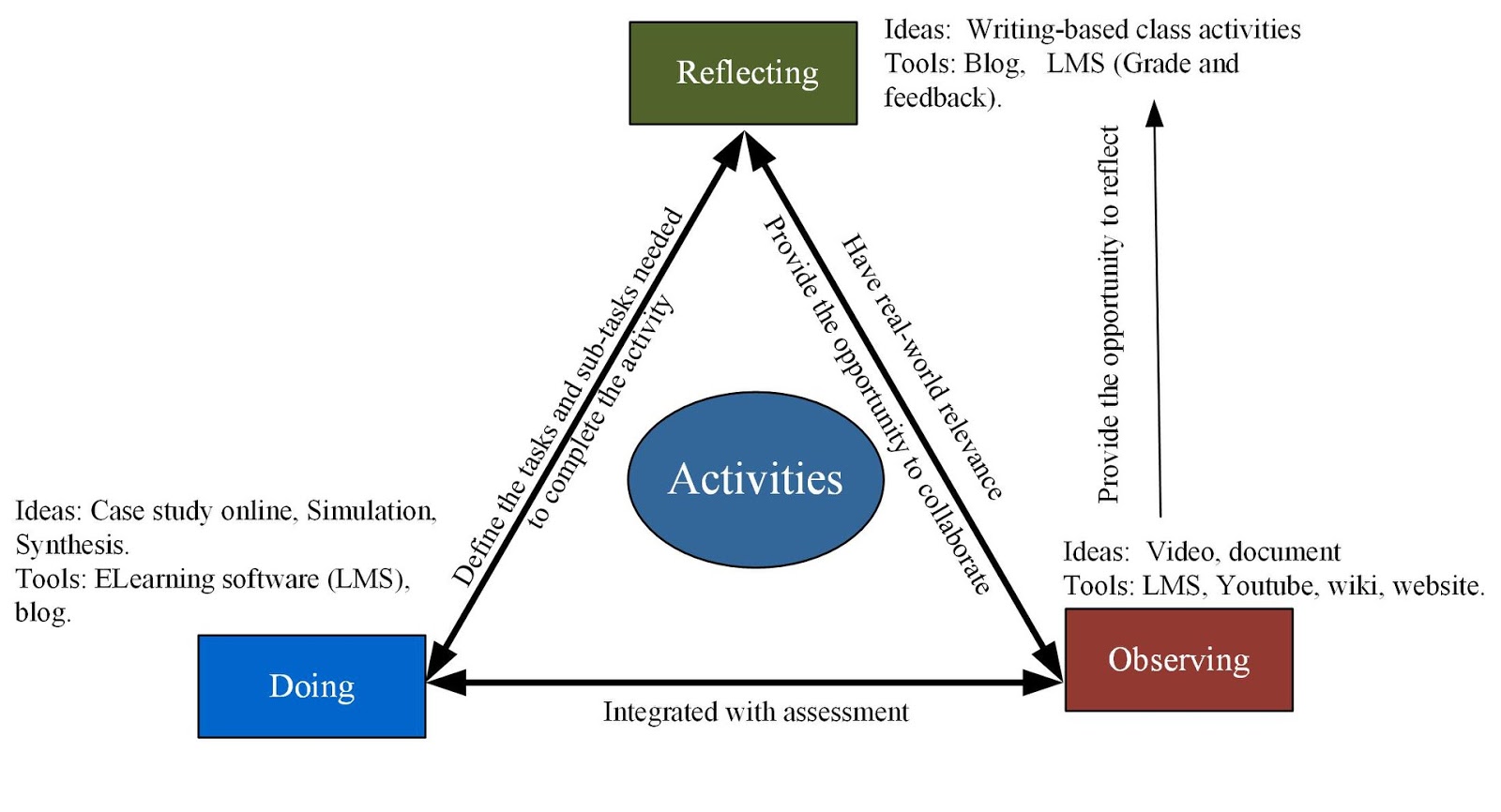
Students have a habit of completing assignments online instead of watching lectures and/or reading document. One of the solutions is to encourage students to complete lessons is to embed quiz scattered in videos or documents. In addition, from practical study at Lac Hong University proposed an active online model for teaching online as shown in Figure 1.
Accordingly  active model for online activities, the teachers need to bring up topics in the real world, build opportunities for cooperation and create feedback opportunities in a virtual environment for learners to respond to topics. However, in order to accomplish the activity, teachers need to build activities for learners through video, documents and / or websites. Practical activities in distance learning mode are very different from the bleded training mode. In order to implement hands-on activities, teachers need to build research topics based on online topics such as simulating  and synthesizing materials from which to write feedback on learners' practice  activities

Saturday, November 9, 2019

Techno-Economic Analysis of Solar Power Plant Project in Binh Thuan, Vietnam

Abstract:
This paper aims to determine the important parameters of the solar power plant project located in Binh Thuan such as energy production, the number of solar panels, the number of the inverters and economic analysis. In this study, the solar power plant project with 1MW capacity installed and the location has the solar radiation from 1800 kWh/m 2 to 1900 kWh/m 2 per year is used to analyze. The PVSyst software was used to determine the energy production, the number of inverters, and the number of the solar panels. Furthermore, an economic model was proposed and used to identify the Net Present Value (NPV) with the discount rate 8% and 10%, Internal Rate of Return (IRR), Levelized Cost of Energy (LCOE) and payback years. From the results, the energy produced was around 1631MW per year, and NPV with discount rate 8% were beneficial, and LCOE was 21 cents USD per kWh. In addition, with the price to sell of electricity production to EVN was 9.35 cents, the Payback years was within in the range 9-12 years.


Digital Pedagogy

In recent year, We have heard a lot about education 4.0 so how to implement the education model 4.0. One of the new pedagogy is digital pedagogy. After discussing digital pedagogy we should be understood the Effectiveness of teaching and learning methods (Fig 1)
988f32166342ea12b010ee669aa6b78a.png
We must be thinking about this model and how to apply it to our class. Furthermore, the teacher creates a digital environment and posts the document, video or/and quizz. The student can study anywhere it makes the student free, it called flexible learning. In other hands, the teacher organizes dialog, through classroom dialog students understand each other better and learn from each other.
From the main point in this topic, digital pedagogy impact on teaching and learning. The teacher must study about technology and change teaching method, the student change method learning from negative to positive and free. I call Flexible teaching and learning

First week for education 4.0 project in Finland

Education 4.0 is an education that meets the human resource requirements of Industry 4.0, where human and technology are aligned to enable new possibilities [1].  So what is the pedagogy should be applied to solve this problem.
During one week in Hank University, my teacher (Irma, Sanna, Catja) gave me something new. Firstly, The important thing was the teacher understanding what was in mind of the student. I was amazed by the method Sana was applying, each person selects a picture that they like and shared their feelings about that picture. Through the short dialog, the lecture understands the feeling of student and change the method to approach the student. Secondly, I have learned the tool to support for teaching such as Moodle, Kahoot, Zoom.  Although I have applied these tools in teaching at LHU but I still learn many new things.  Finally, I visited another campus of Hamk university and I amazed about the curriculum-based module and the teacher will share with us next week. 
IMG_20190918_115844.jpg
Fig 1. The Vietnamese student in Hamk University
I and my team have a good time in Finland. The weather and food are the difference in Vietnam but it gives me a new experience.  My first impression about the environment in Finland was fresh air and lots of trees. We have a good trip on the weekend to Helsinki and Tallinn. It is nice and romantic.
71477755_10217139574413823_7592308955808792576_n.jpg
Fig 2. Tallinn old town

Fig 3. Hamk University
[1]Anealka Aziz Hussin,.Education 4.0 Made Simple: Ideas For Teaching, International Journal of Education & Literacy Studies.